
This week the crew covers everything from beach vacations and superhero movies to fascinating new discoveries about the human brain and the future of artificial intelligence. Devon reports back from a family-filled Mississippi beach trip, Steven shares his thoughts on Supergirl, Ben highlights listener feedback and celebrates a birthday, and the science discussion dives into how anesthetized brains may be doing far more than we ever imagined. Then the conversation shifts into the strange world of AI’s “latent space” and why it may become one of humanity’s most important creative tools.
Real Life
Ben starts things off by wishing a very happy birthday to longtime listener Hank before sharing some thoughtful listener feedback from Episode 615. We always appreciate hearing what everyone thinks, so keep those comments coming!
You can read the feedback here:
https://sciencefactionpodcast.com/2026/07/01/episode-615-spreading-the-word-of-totally-local-ai/#comment-151
Devon returns from a family vacation in Long Beach, Mississippi. Between the huge gathering of relatives, plenty of kids running around, and an incredibly shallow beach stretching nearly a mile into the Gulf, it was the perfect destination for a laid-back family getaway.
Steven finally catches Supergirl and discovers a movie that lands squarely in the middle of the review spectrum. While online opinions seemed split between “masterpiece” and “disaster,” the film ended up being… fine. The crew discusses its themes surrounding human trafficking and the metaphor of women having their power stripped away, while also pointing out that the constant switching of powers eventually became distracting. Despite its flaws, everyone agrees the performances, visual effects, and sound design were excellent, with Ben giving special praise to the imaginative creature designs.
Future or Now
Devon brings a study that challenges what we thought we knew about consciousness.
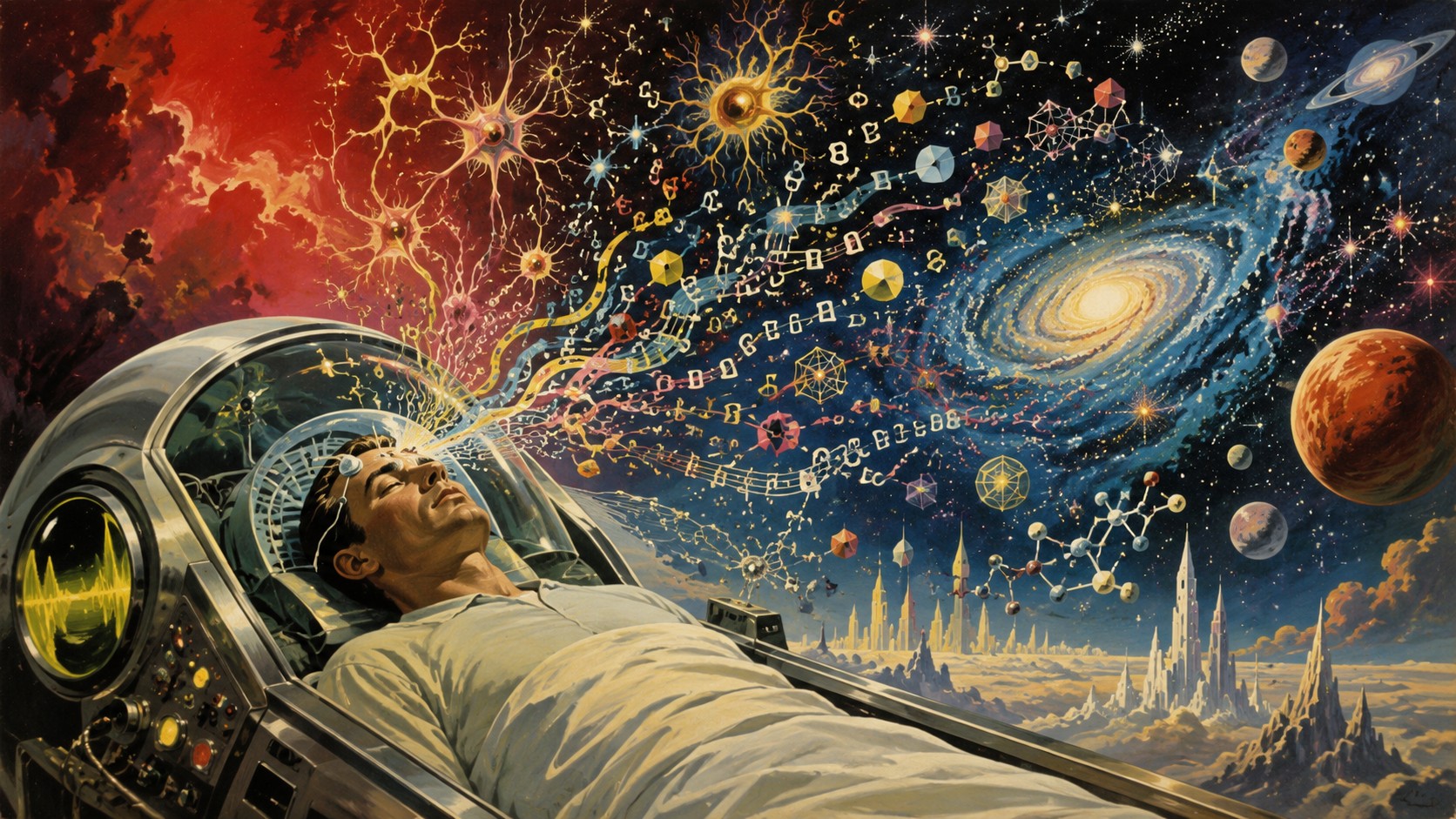
Researchers discovered that people under general anesthesia may continue processing language at a surprisingly sophisticated level. Even while completely unconscious, patients could distinguish different types of words and showed neural activity suggesting they were predicting upcoming words before hearing them. The findings raise fascinating questions about what consciousness really is and could eventually influence both anesthesia research and future brain-computer interfaces.
Read more:
https://www.sciencedaily.com/releases/2026/06/260624025514.htm
Ben explores Kevin Kelly’s idea that latent space is becoming an entirely new creative medium.
Rather than acting as giant databases that memorize information, modern AI models compress enormous amounts of human knowledge into abstract mathematical relationships. This “latent space” becomes something people can navigate—moving between concepts, artistic styles, scientific ideas, or even alternate histories. Kelly argues that this shared conceptual landscape could become a platform for scientific discovery, personalized AI systems, and entirely new ways of thinking, where generating ideas and thinking become nearly the same process.
Read Kevin Kelly’s article here:
https://kevinkelly.substack.com/p/latent-space-as-a-new-medium
Steven wraps up the discussion with a practical example of AI in everyday life, explaining how it helped troubleshoot and update his Raspberry Pi Pi-hole installation. What could have been a frustrating afternoon of terminal commands and Linux troubleshooting turned into a quick collaborative problem-solving session, highlighting how AI can be just as useful for practical technical tasks as it is for creative ones.
Thanks for listening! If you enjoy the show, be sure to subscribe, leave us a review, and share the podcast with a friend. Your support helps us keep exploring the latest science, technology, and the wonderfully weird stories that make Science Faction what it is.
Leave a Reply