
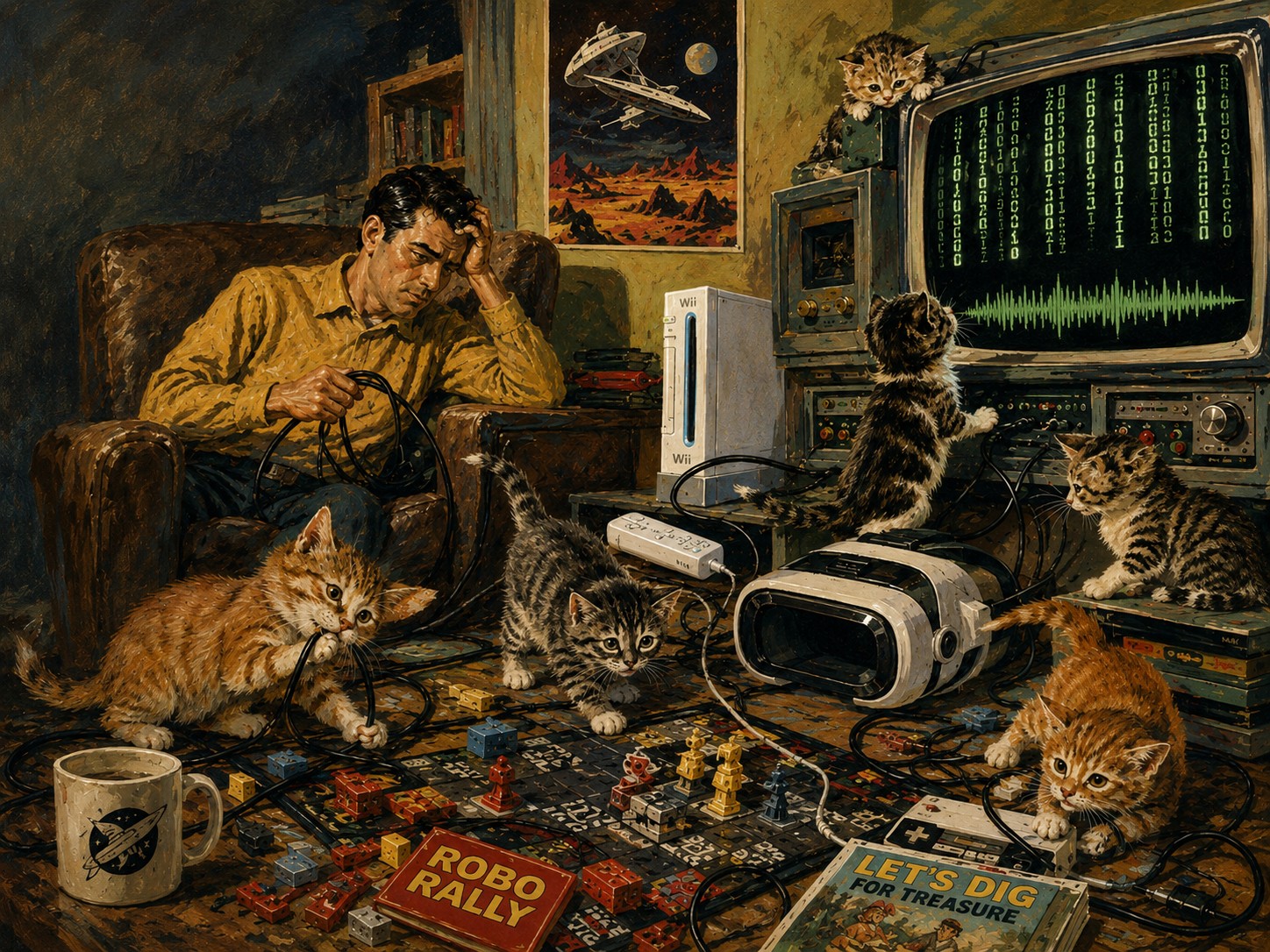
This week the crew deals with sick kids, travel chaos, and kitten catastrophes before diving into ancient supervolcanoes, bizarre retro coding experiments, and a deeply unsettling sci-fi moral dilemma inspired by Star Trek: Deep Space Nine.
Real Life
Steven’s week turned into a strange mix of California road trips, tactical miniatures combat, and disease management. Devon came out for a visit, which meant plenty of hanging out, board games, and attempts to squeeze hobby time into an already overloaded week. Steven got to play some Robo Rally with Greg and Robert, along with trying out Let’s Dig for Treasure, a game whose title sounds wholesome but absolutely invites goblin behavior.
Meanwhile, Steven continued the noble quest of teaching Star Wars: Shatterpoint to Devon while Ben allegedly “rested,” which is apparently code for strategically avoiding rules explanations and measuring tools. Steven also spent another week in solo dad mode, which became significantly harder once kid sickness entered the arena and started critting morale checks.
Ben, meanwhile, remains trapped in the ongoing kitten saga. The kittens continue producing biological surprises at an industrial pace, while Ben contemplates the eternal debate between older gaming hardware and modern VR technology. Specifically: the Wii may have looked ridiculous, but at least it wasn’t trying to strangle your family with cords every time somebody turned around. According to Ben, the Wii was “for moms,” which honestly may have been Nintendo’s most successful market strategy ever.
Devon was not present for this segment because he was likely somewhere over the western United States eating airport pretzels and regretting flight delays.
Future or Now
Ben descended into the strange and fascinating world of the demoscene with “Wake Up, Neo,” a tiny 16-byte x86 program capable of turning cascading Matrix-style code into sound. Yes: sixteen bytes. Not sixteen kilobytes. Sixteen actual bytes. The conversation spiraled into appreciation for the demoscene itself — a long-running culture of programmers creating absurdly impressive audiovisual experiments under ridiculous technical limitations.
- “Wake Up, Neo” writeup:
Wake Up, Neo - Demoscene overview:
Demoscene Wikipedia Page
Steven brought humanity to the brink of extinction with the story of the Toba supereruption. Scientists believe the eruption may have darkened skies and cooled the planet so severely that early human populations nearly collapsed. But newer archaeological evidence suggests humans may have been far more adaptable than previously believed.
Instead of folding under pressure, ancient communities appear to have shifted strategies, developed new tools, and survived conditions that should have wiped them out. In other words: humanity’s greatest evolutionary trait may not be intelligence, strength, or speed — it may simply be the stubborn refusal to quit.
- ScienceDaily article:
Toba Supereruption Research
Devon once again contributed by existing somewhere inside the airline system.
“Big Question”
This week’s Big Question was deeply uncomfortable in exactly the way a good science fiction premise should be:
Would you rather have actually killed someone and have absolutely no memory of it… or have vivid memories of killing someone when it never actually happened and could never be proven true?
Ben immediately pointed out the horrifying lack of control involved in the first option. Somewhere out there, a terrible thing happened, and you were responsible for it without even knowing. That uncertainty alone could eat someone alive.
Steven argued the second option might actually be worse for him personally. Even if the memory were false, the emotional weight would still feel real. Guilt doesn’t necessarily care whether something objectively happened. If your brain fully believes you murdered someone, your nervous system probably isn’t going to politely wait for evidence before spiraling.
The conversation naturally drifted into Star Trek: Deep Space Nine and the famous episode Hard Time, where Chief O’Brien receives implanted prison memories so traumatic they permanently alter him psychologically.
- Episode reference:
Hard Time (DS9)
It turns out fake trauma may still just be… trauma. Which is a pretty bleak realization for a podcast episode that also contained kitten poop discussions.
Thanks for listening to another episode of The Science Faction Podcast! If you enjoy weird science, existential sci-fi questions, retro tech rabbit holes, and hearing exhausted dads attempt coherent conversation, consider supporting the show on Patreon for bonus episodes, Discord access, AI art, unedited recordings, and more. You can also subscribe on YouTube and help spread the word to fellow science-fiction weirdos.
Leave a Reply