
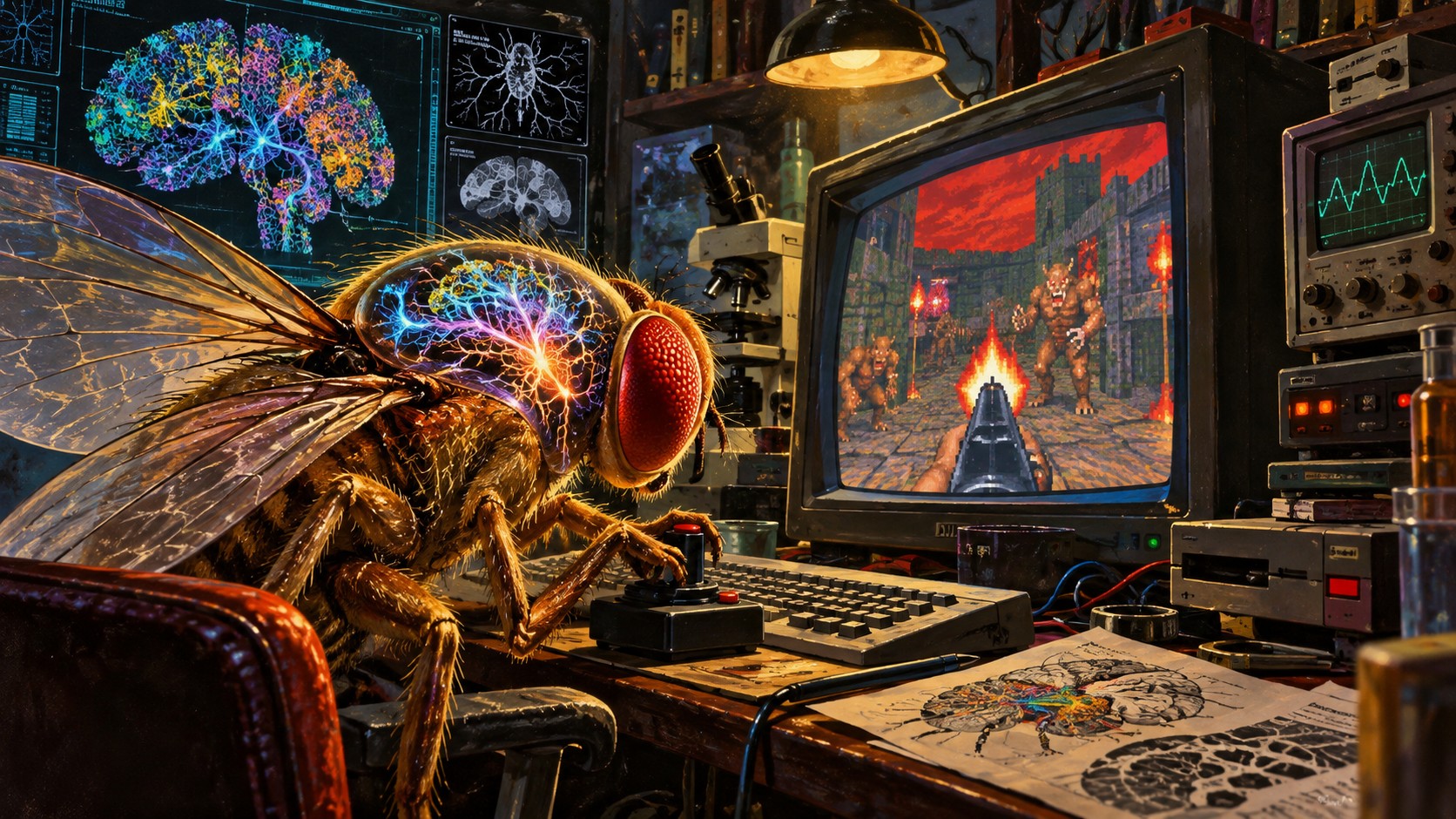
This week on Science Faction, we’ve got VR mini golf inside a gelatinous lair, Lanterns continuing its hot streak, questionable Resident Evil continuity, and Devon discovering that talking about guitar theory apparently removes all normal limits on podcast airtime. Then we get into the science: human neurons growing inside mouse brains and the complete nervous system of a fruit fly being reconstructed digitally—because apparently mapping a brain isn’t enough anymore. Now we need to see if it can play Doom.
Real Life
Ben has been back in Walkabout Mini Golf, checking out Gloop Lair, a new course that sends players into a wonderfully strange underground world filled with colorful goo, bizarre environments, and exactly the sort of elaborate miniature-golf nonsense that keeps us coming back to this game.
Gloop Lair:
https://www.mightycoconut.com/gloop-lair
Steven continues his weekly declaration that Lanterns is amazing, this time after Episode 6. We also get a Nathan Fillion sighting as Guy Gardner, which naturally gives us another excuse to talk about superheroes.
Steven has also fallen even farther down the vibe-coding rabbit hole. The latest project is CRAWLBOX, a loot-box generator built for the Dungeon Crawler Carl RPG. What started as a relatively simple helper for generating rewards has, predictably, turned into an increasingly elaborate system for creating randomized weapons, armor, magic items, consumables, enchantments, and other crawler loot.
Try CRAWLBOX:
https://dungeon-crawler-loot.stevezero.chatgpt.site
Ben brings us the strange crossover between The Rookie and Dropout, which raises some questions about what happens when a network procedural collides with the very different world of internet comedy.
Read more at IndieWire:
https://www.indiewire.com/features/commentary/dropout-the-rookie-crossover-controversy-explained-1235182321/
Steven also watched the latest Resident Evil movie. Is it a reboot? Is it connected to something else? Does any of that actually matter? Who knows. What we do know is that it was an entertaining distraction that seems squarely aimed at a younger, roughly 18–24 audience.
Meanwhile, Devon is tired and claims he hasn’t been doing much—which somehow turns into an extended discussion about learning Bullet for My Valentine songs, taking guitar lessons online, and studying the CAGED system.
And then something remarkable happens: Devon starts talking about music.
And keeps talking.
And keeps talking.
Steven eventually has a more fundamental question: Why is Devon putting this much effort into learning all of this guitar stuff? That launches us into a much bigger conversation about learning an instrument, understanding music instead of simply playing songs, and why apparently the secret to getting Devon to talk forever is mentioning a fretboard.
Future or Now
Human Neurons…Inside Mouse Brains
Devon brings us a story that sounds like the opening act of a science-fiction movie: researchers are growing human neurons inside mouse brains.
Scientists are using these transplanted human cells to study how neurons develop and behave inside a living brain, potentially giving researchers a new way to investigate neurodevelopmental disorders that are difficult to reproduce using traditional laboratory models.
It’s fascinating research.
It’s also one of those sentences where every additional explanation somehow makes it sound more like science fiction.
Read the Science article:
https://www.science.org/content/article/human-neurons-flourish-mouse-brains-offering-new-view-neurodevelopmental-disorders
We Mapped a Fruit Fly Brain. Naturally, We Made It Play Video Games.
Steven’s story starts with a major scientific achievement: researchers produced a remarkably detailed map of the nervous system of an adult male fruit fly.
That alone is impressive. The resulting connectome gives researchers an extraordinary look at how a relatively small biological brain is wired together.
But this is the internet, so obviously somebody had to ask the important question:
Can we use it to play video games?
Researchers and programmers are already experimenting with computational models based on fruit-fly neural circuitry, including attempts to put these systems into virtual environments involving games such as Doom and Super Mario 64.
Which raises some wonderfully strange questions.
If you reproduce the connections inside a brain, how much of the original behavior comes along with it? How much does the body matter? Could increasingly sophisticated connectomes eventually produce useful artificial agents? And, perhaps most importantly, how humiliating will it be when a fruit fly becomes better at Doom than we are?
Read more:
Gizmodo: https://gizmodo.com/google-mapped-a-fruit-flys-brain-now-its-playing-doom-and-super-mario-64-2000808616
Google Research — A Connectomics Milestone: Mapping the Complete Male Fruit Fly Brain:
https://research.google/blog/a-connectomics-milestone-mapping-the-complete-male-fruit-fly-brain/
This week: VR goo, Guy Gardner, vibe-coded loot boxes, entirely too much guitar theory, human neurons living in mice, and a fruit fly learning to play video games.
Just another perfectly normal episode of Science Faction.
Leave a Reply